DSL Marketing Myrlte Beach

Tuesday, March 27, 2012

SEO Tips you need to start using right now

Google’s searchbots have long relied on humans to endorse relevant and useful links. Recently, however, Google upped the human ante by introducing Google Social Search.

Google recognizes that one personal endorsement from someone we know easily outranks endorsements from 10,000 strangers. The same applies for a trusted authority: a blogging link shared by Darren Rowse or Brian Clark carries more weight than something a casual user shares.

So as a result, we have Google Social Search: meaning a site can jump from #30 to #3 in the SERPs just because someone in your Google+ circles shared the link. Getting an RT from The Huffington Post can jump your blog post from #8 to #1. It’s a brave new world of social SEO – and it’s one that no SEO can afford to ignore.

Leveling The Playing Field

Under traditional SEO practices, a modern startup would have no chance at ranking for highly competitive keywords. The other sites have been down in the trenches too long; it’d be nearly impossible to knock them off their SERP pedestal without years of campaigning.

Social SEO makes it easier for smaller fish to compete with the big guys. A tweet that receives a viral-size number of retweets can mean as much as a link from a top-ranking site; a +1 from a friend can send your site to the top of the social SERPs for that friend’s entire network.

Social media should already be a part of your business strategy. Now it’s time to harness the power of those social media accounts for your SEO strategy – or risk falling behind while your competitors cash in on their social chips.

Social Strategies To Start Employing Today

1. Ramp Up Your Google+ Presence

It’s the most obvious one on the list, but it still needs to be said. Like it or not, Google has made it clear that G+ is here to stay – and it’s become too useful for an SEO not to take advantage it.

Though the network is still a lightweight compared to sites like Twitter and Facebook, Google+ is emerging as a champion heavyweight in search results.

As seen in the screenshot below, casual G+ posts are even showing up in search results:
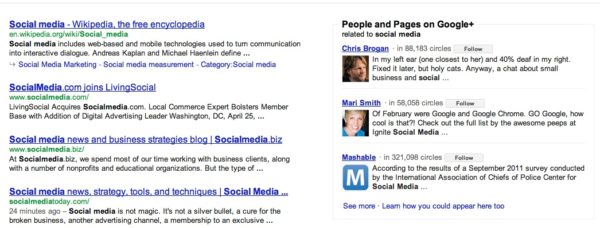
Google+ results

Think Google+ search results are just limited to social search? Think again. Related Google+ users and pages show up in standard Web search, too:
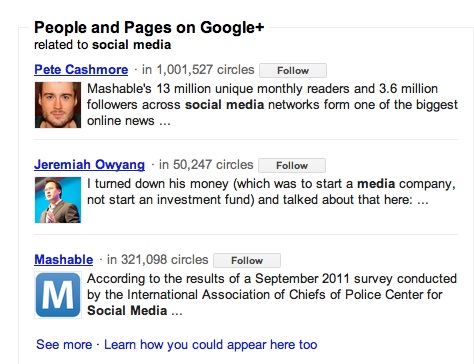
Google+ non-social search results

From authorship to +1s to shares to circle numbers, Google is injecting social G+ results into nearly every Google Social search. Jumping to a first-page ranking solely because someone put you in a G+ circle? That’s a benefit no site can afford to ignore.

2. Put A New Emphasis On Building Relationships & Increasing Followers

Everything you write or share can pop up in your followers’ search results – even if they’re not a member of the social site you shared the link on. The relationships we forge online now have a huge impact on our search results.

Every new follower you get may see your brand’s site in his or her SERPs in the future, so it’s in your best interest to ramp up your follower count. Host a giveaway (entrants must follow you on G+, for example), increase your outreach efforts, or give away an eBook exclusively for your followers.

3. Start Posting Your Articles Immediately On Social Media

As Mitch Monsen of White Fire SEO pointed out, tweeting your content actually helps your content get indexed faster (especially vital if you’re posting time-sensitive material). Set your articles to automatically post on Google+, LinkedIn, etc. and you’ll get indexed even quicker.

4. Focus On Shareable Content

Social shares have always worked in a SEO’s favor by granting us endorsements similar to direct inbound links. Now, shares have another benefit: if someone (even someone that doesn’t follow you on any social media sites) shares your content, the sharer’s entire network may see the post by searching for relevant material in Google Social Search.

Getting someone like, say, Newsweek to share your material? In addition to getting a nice boost in your rankings, you’ll also have access to that power user’s network.

5. Add +1 Buttons To Anything & Everything

Have you noticed that Google’s even added +1 buttons to their ads? The +1 has turned into an Internet-wide Facebook like button.Don’t turn down the easy endorsement: slap the +1 button on your site wherever you can.

6. Use “Rel=author” & “Rel=me” Tags To Link Your Work To Your Name
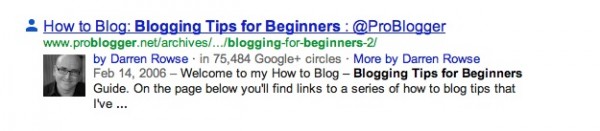
Darren Rowse Authorship in Google+

Searchers can now see thumbnails of the person who authored the article they’re about to read. If they liked what they read, they can simply return to the SERP and click “More by ________” to see the author’s entire catalogued body of work.

To clue Google in that you’re the author, you’ll need to use “rel=author” tags in your posts. Not sure how? Joost de Valk’s already written a comprehensive guide on the subject – and so has Google.

7. Get On Pinterest

PinterestI know it’s rapidly becoming a cliché to write about Pinterest, but the newest social site on the block has well-earned its praise due to its sheer SEO power.

This simple graphic from The Wall Street Journal nabbed the website nearly 1500 shares on Pinterest (and countless more traffic):

You probably already know Pinterest sends nearly as much referral traffic as Twitter (and more than YouTube, G+, and LinkedIn combined), but did you know Google now crawls pins and boards?

Optimize your pins for relevant search keywords; further optimize for Pinterest searches by hashtagging relevant keywords on each pin.

8. Add A “Pin It” & A StumbleUpon Button To Your Site

Take the shares anywhere you can get them. The aforementioned Pinterest has killer link traction, while the social bookmarking powerhouse StumbleUpon is second only to Facebook in terms of referral traffic.

Slap both “Pin It” and StumbleUpon buttons on your content right next to the Facebook, Twitter, and +1 buttons.

A Brief Word To The SEO Traditionalists

Am I suggesting social SEO practices are rapidly replacing traditional SEO methods?

Absolutely not.

Am I suggesting social SEO is better than traditional SEO?

Absolutely not.

Traditional SEO isn’t going anywhere any time soon. However, as social becomes increasingly integrated with search, it’s time to add social media as a permanent tool in our SEO arsenal.

Opinions expressed in the article are those of the guest author and not necessarily Search Engine Land.

Monday, March 19, 2012

Online Video Marketing Survey and Video Email Trends Report

Web Video Marketing Council and Flimp Media Release Results of Q4-2011 Online Video Marketing Survey and Video Email Trends Report 81 Percent of Marketers Already Using Online Video; 52 Percent are Using with Email; 67 Percent Have Posted to Websites and 61 Percent Have Posted to Social Media Sites

Hopkinton, MA, March 19, 2012 --(PR.com)-- The Web Video Marketing Council and Flimp Media have just released the results of the Q4-2011 Video Marketing Survey of more than 270 interactive marketing professionals. The white paper report reveals that most marketers are already using video for online marketing and that 64 percent of marketers plan to increase their video marketing budget in 2012. According to the recent survey, online video use increased to 81 percent of marketers during 2011 and 52 percent of marketers said they were using video with email marketing programs in 2011.

In general, surveyed marketers were very optimistic about the performance of video with email, as 88 percent indicated that integrating video with email marketing has had a positive effect on their email marketing efforts. In addition, 72 percent believed that buyers were more likely to purchase or convert after viewing an email campaign that incorporated video. Only one percent of marketers surveyed indicated that video had a negative effect on their email marketing efforts. In light of these results it was surprising that 35 percent of marketers said their email service provider did not offer a video marketing solution and 44 percent did not know if their email provider offered a video marketing solution.

The survey was conducted by the Web Video Marketing Council in conjunction with Flimp Media in Q4 of 2011. The study queried more than 270 interactive marketing professionals who “have marketing oversight responsibilities in their role” in order to gain insights into current marketing practices and perceptions regarding video-based email marketing. The survey results and 2011 Video Email Marketing Trends Report are available for download here: http://www.webvideomarketing.org/pdf/Q4-2011 Online Video Marketing Survey.pdf

Speaking about the survey, Paul Ritter, Director of Strategic Programs for the Web Video Marketing Council commented: "We knew that there was strong interest among marketers in online video marketing, and specifically email marketing, but were surprised by the current adoption levels over 80 percent and the overwhelming sentiment that video email increases click thru rates and purchases. This is definitely a strong online marketing trend to watch.”

The survey also asked marketers what they think are the most effective ways to deploy video with email and what they believe are the primary barriers to using video with email marketing. “At the top of the list of barriers cited by marketers for using video in email marketing was not having readily available video assets to use in their campaigns,” reports Ritter. “We fully expect this number to drop over the course of the year with the increasing availability of high megapixel cameras that are becoming more available on devices such as iPads and Smartphones that can produce high quality video content. There will always be a need for high production value videos involving a camera crew and professional editors.”

Wayne Wall, CEO of Flimp Media, a co-producer of the survey said “There seems to be a consensus of belief among marketers that video produces higher email engagement and response rates. Since 2008 we have conducted well over a thousand video marketing campaigns for clients using trackable video email postcards for lead generation and communications. Our aggregate marketing data shows an average viewer engagement time of 1.3 minutes, response rates averaging 23 percent and email click thru rates well over 30 percent when deploying video with email marketing.”

Download the 2011 Video Email Marketing Survey Data and Industry Trends Report
Access the survey results and download the 2011 Video Email Trends Report from this link: http://www.webvideomarketing.org/pdf/Q4-2011 Online Video Marketing Survey.pdf

About the Web Video Marketing Council
The Web Video Marketing Council (WVMC) is a professional association established to provide timely, relevant information about online video marketing topics and technologies to professional marketers and communicators through its website, newsletter, reports and webinars. For more information please visit our website, www.webvideomarketing.org.

About Flimp Media
Flimp Media is a video lead generation and communications solutions provider located in Boston, MA. FLIMP® which stands for Flexible Interactive Marketing Platform is a SAAS solution used to create, distribute and track interactive video postcards for email lead generation and corporate video communications. Flimp Media also provides video production, Video SEO and creative services for a diverse and rapidly expanding collection of clients. For more information, please visit www.flimp.net and www.flimpagency.com.

Contact Information:
Web Video Marketing Council
Jennifer O'Meara
508-435-5220
Contact via Email
webvideomarketing.org/

Click here to read the full story: Online Video Marketing Survey and Video Email Trends Report

Thursday, March 8, 2012

What Does Apple's New iPad Mean for Marketing?

Apple's iPad has dazzled consumers. And the latest model, unveiled today, includes features that marketers will need to consider in the coming year.

In fact, Apple CEO Tim Rose said Apple sold 15.4 million iPads last quarter, which is more than the sales at any individual PC company during the same period, BusinessInsider reported.

Three marketers, in email interviews with ClickZ, shared how they anticipate the tablet will affect marketing in the coming year.

Better Display

"Certainly the retina display makes a big difference. At 264 pixels per inch, the new iPad has twice the resolution of iPad2 (in fact, it's got more memory and a better screen resolution than an Xbox 360 or PS3), and that translates into a bigger canvas on which to create more powerful digital experiences," said Andrew Solmssen, a managing director at Possible Worldwide.

Improved Camera for Video, Still Images

"Marketers should definitely be excited about the much improved video camera and camera, which will enable more sophisticated apps with functionality such as facial recognition," Solmssen said. "The boost in video camera performance will also improve consumers' ability to capture videos to contribute to campaigns."

Faster Download Speeds

"With 4G LTE, the new iPad is capable of download speeds up to 73 Mbps, and more bandwidth opens the door for more immersive, interactive marketing and ad work," Solmssen added.

Robert Weber, a founder of W3i, concurred. "The biggest impact for marketers will be LTE support. This will dramatically increase internet speeds and result in the ability to create much more engaging app experiences," he said.

High-Quality Device Deserves High-Quality Content

"The new iPad delivers more of everything to the consumer, and marketers need to do the same," said Melissa Krueger, senior marketing consultant, ExactTarget. The new iPad offers a higher resolution display than the iPad 2 and promises a faster processor.

She pointed out that primary uses of the device are "entertainment, exploration, and self-expression in a low effort, 'lean back' environment." And as a result, she said, marketers must consider how their offerings coincide with these uses and mindset. "It's really all about high quality content that is pleasurable to consume and easy to manipulate and share," she said.

And What's Missing…

"These new features also highlight what iPad is still missing - specifically, an exciting, standardized ad model. iAd has been anemic at best on iPad and is due for a serious refresh. Advertisers also need a library of actions that they can use to quickly and easily make creative that, as described above, takes advantage of the tablet for what it does best," Solmssen said.

Monday, February 27, 2012

Myrtle Beach Vote #6 Worlds Best Beach

Here's the list, which was generated by TripAdvisor's Travelers' Choice Awards 2012:

World’s Best Beaches

  1. Providenciales, Turks and Caicos
  2. Boracay, Philippines
  3. Palm/Eagle Beach, Aruba
  4. Negril, Jamaica
  5. Tulum, Mexico
  6. Myrtle Beach, United States
  7. Seven Mile Beach, Grand Cayman
  8. Punta Cana, Dominican Republic
  9. Cape May, United States
  10. Santa Teresa, Costa Rica
  11. Maldives
  12. Panama City Beach, United States
  13. Miami Beach, United States
  14. Bora Bora, French Polynesia
  15. Isla Mujeres, Mexico

REad the entire article HERE.

Thursday, February 2, 2012

Facebook's IP and the Future of Online Marketing

It’s only the second day of February and we’re ready to get a running start on the month with tons of interactive marketing news. Yesterday, as Google + reportedly hit 100 million users, Facebook filed for its $5 billion IPO. $5 billion is less than originally predicted, but still manages to make Facebook’s filing – if Mark Zuckerberg and is team raises the money – one of the biggest tech IPOs ever.


Facebook and Google +… The Future of the Online World?

While many people – like users on our Facebook page – view this as the next web bubble, sure to pop soon (we all saw how LinkedIn did after filing – as in, not too well in the months following its IPO), others view this as the beginning of the trend toward social as the future of an open, collaborative and connected internet. And Google + obviously hopes to be a large part of this future as well, as, according to Paul Allen on Wednesday, Google +’s numbers are growing, and growing quickly: “Google+ membership has grown more than 10% since Jan. 19th when Larry Page announced 90 million users. I have them at 100.8 million users by the end of the day.” The same old question persists: is this reflective of how many people are using Google + actively? And a new question arises: is this simply because, as of recently, anyone who signs up for a Google service has to create a Google + profile? It’s hard to believe that’s not the case.
Zuckerberg’s Vision

Regardless, social is clearly a large part of all of our lives. Zuckerberg’s vision is one of continued innovation and openness, as he states in his open letter to possible shareholders upon filing. He writes:

“Today, our society has reached another tipping point. We live at a moment when the majority of people in the world have access to the internet or mobile phones — the raw tools necessary to start sharing what they’re thinking, feeling and doing with whomever they want. Facebook aspires to build the services that give people the power to share and help them once again transform many of our core institutions and industries. There is a huge need and a huge opportunity to get everyone in the world connected, to give everyone a voice and to help transform society for the future…. By helping people form these connections, we hope to rewire the way people spread and consume information. We think the world’s information infrastructure should resemble the social graph — a network built from the bottom up or peer-to-peer, rather than the monolithic, top-down structure that has existed to date. We also believe that giving people control over what they share is a fundamental principle of this rewiring.”

There’s already not much in the way of Facebook getting exactly what Zuckerberg wants, with a majority of people actively using the social platform to connect with others and build and maintain relationships. With a $5 billion IPO, there’s even less standing in the way of Facebook creating a very social future.
Speaking of Spending…

What does this mean for search marketing? Is social the only way of the future? No way. In fact, at the end of January, an eMarketer report revealed that projections have search ad spending trending upwards in the coming years. Specifically, the report says, “search spending will rise 27% to $19.51 billion. By 2016, search ad spending will approach $30 billion, following slower but consistent growth between now and then.”

This graph, courtesy of eMarketer, reflects a projected rise in search spending through 2016.

The report also predicts that Google will see the most revenue growth this year, but that Google’s growth rates will likely be surpassed by Microsoft in 2013 and 2014 (bold statement!). However, the report ads, “Still, by that point Google will have nearly 10 times Microsoft’s search ad revenue—$20.28 billion vs. just $2.21 billion” (and you thought Facebook’s $5 billion was a lot. Chump change!).

eMarketer adds that Google will not lose its first place position as the number one ad market dominator, as the search engine will see 77.9% of all US search ad revenues in 2012. eMarketer adds that, 2 years from now, that percentage will grow to nearly 80. The report also places Google, Microsoft, Yahoo! and AOL at the top of the search ad marketing pile, noting that, “By 2014, search revenues at Google, Microsoft, Yahoo! and AOL will account for 92.1% of all US search ad revenues and 44.3% of all US online ad revenues, up from just under 90% of all search ad revenues and 43% of all US online ad revenues in 2011.”
Social AND Search (Especially Paid) Here To Stay

As you can tell, paid search isn’t going anywhere. People are investing in search marketing and will continue to do so because it’s a viable marketing area and, when they have patience and do it right, many businesses experience high ROI from their online efforts. Combine those efforts with an interactive social media presence, and you have a business that is successfully marketing for the future.

Tuesday, January 24, 2012

Pages With Too Many Ads “Above The Fold” Now Penalized By Google’s “Page Layout” Algorithm

Do you shove lots of ads at the top of your web pages? Think again. Tired of doing a Google search and landing on these types of pages? Rejoice. Google has announced that it will penalize sites with pages that are top-heavy with ads.

Top Heavy With Ads? Look Out!

The change — called the “page layout algorithm” — takes direct aim at any site with pages where content is buried under tons of ads.

From Google’s post on its Inside Search blog today:

We’ve heard complaints from users that if they click on a result and it’s difficult to find the actual content, they aren’t happy with the experience. Rather than scrolling down the page past a slew of ads, users want to see content right away.

So sites that don’t have much content “above-the-fold” can be affected by this change. If you click on a website and the part of the website you see first either doesn’t have a lot of visible content above-the-fold or dedicates a large fraction of the site’s initial screen real estate to ads, that’s not a very good user experience.

Such sites may not rank as highly going forward.

Google also posted the same information to its Google Webmaster Central blog.

Sites using pop-ups, pop-unders or overlay ads are not impacted by this. It only applies to static ads in fixed positions on pages themselves, Google told me.

How Much Is Too Much?

How can you tell if you’ve got too many ads above-the-fold? When I talked with the head of Google’s web spam team, Matt Cutts, he said that Google wasn’t going to provide any type of official tools similar to how it provides tools to tell if your site is too slow (site speed is another ranking signal).

Instead, Cutts told me that Google is encouraging people to make use of its Google Browser Size tool or similar tools to understand how much of a page’s content (as opposed to ads) is visible at first glance to visitors under various screen resolutions.

But how far down the page is too far? That’s left to the publisher to decide for themselves. However, the blog post stresses the change should only hit pages with an abnormally large number of ads above-the-fold, compared to the web as a whole:

We understand that placing ads above-the-fold is quite common for many websites; these ads often perform well and help publishers monetize online content.

This algorithmic change does not affect sites who place ads above-the-fold to a normal degree, but affects sites that go much further to load the top of the page with ads to an excessive degree or that make it hard to find the actual original content on the page.

This new algorithmic improvement tends to impact sites where there is only a small amount of visible content above-the-fold or relevant content is persistently pushed down by large blocks of ads.

Impacts Less Than 1% Of Searches

Clearly, you’re in trouble if you have little-to-no content showing above the fold for commonly-used screen resolutions. You’ll know you’re in trouble shortly, because the change is now going into effect. If you suddenly see a drop in traffic today, and you’re heavy on the ads, chances are you’ve been hit by the new algorithm.

For those ready to panic, Cutts told me the change will impact less than 1% of Google’s searches globally, which today’s post also stresses.

Fixed Your Ads? Penalty Doesn’t Immediately Lift

What happens if you’re hit? Make changes, then wait a few weeks.

Similar to how last year’s Panda Update works, Google is examining sites it finds and effectively tagging them as being too ad-heavy or not. If you’re tagged that way, you get a ranking decrease attached to your entire site (not just particular pages) as part of today’s launch.

If you reduce ads above-the-fold, the penalty doesn’t instantly disappear. Instead, Google will make note of it when it next visits your site. But it can take several weeks until Google’s “push” or “update” until the new changes it has found are integrated into its overall ranking system, effectively removing penalties from sites that have changed and adding them to new ones that have been caught.

Google’s post explains this more:

If you decide to update your page layout, the page layout algorithm will automatically reflect the changes as we re-crawl and process enough pages from your site to assess the changes.

How long that takes will depend on several factors, including the number of pages on your site and how efficiently Googlebot can crawl the content.

On a typical website, it can take several weeks for Googlebot to crawl and process enough pages to reflect layout changes on the site.

Our Why Google Panda Is More A Ranking Factor Than Algorithm Update article explains the situation with Panda, and how it took time between when publishers made changes to remove “thin” content to when they were restored to Google’s good graces. That process is just as applicable to today’s change, even though Panda itself now has much less flux.

Meanwhile, Google AdSense Pushes Ads

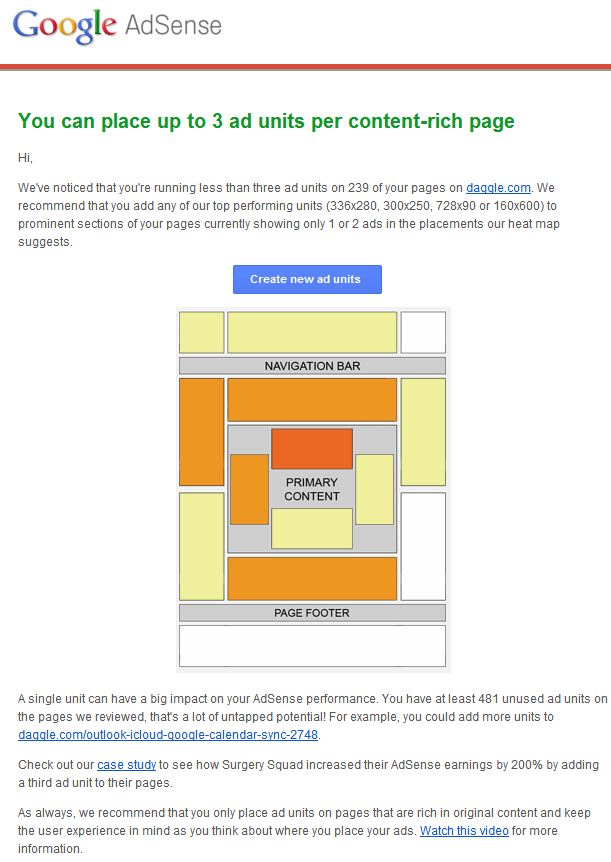
Ironically, on the same day that Google’s web search team announced this change, I received this message from Google’s AdSense team encouraging me to put more ads on my site:

This was in relation to my personal blog, Daggle. The image in the email suggests that Google thinks content pretty much should be surrounded by ads.

Of course, if you watch the video that Google refers me (and others) to in the email, it promotes careful placement, that user experience be considered and, at one point, shows a page top-heavy with ads as something that shouldn’t be done.

Still, it’s not hard to easily find sites using Google’s own AdSense ads that are definitely pushing content down as far down on their pages as they can or trying to hide it. Those pages, AdSense or not, are subject to the new rules, Cutts said.

Pages Ad-Heavy, But Not Top-Heavy With Ads, May Escape

As a searcher, I’m happy with the change. But it might not be perfect. For example, here’s something I tweeted about last year:

Yes, that’s my finger being used as an arrow. I was annoyed that to find the actual download link I was after was surrounded by AdSense-powered ads telling me to download other stuff.

This particular site was heavily used by kids who might easily click on an ad by mistake. That’s potentially bad ROI for those advertisers. Heck, as net-savvy adult, I found it a challenge.

But the problem here wasn’t that the content was pushed “below the fold” by ads. It was that the ratio of ads was so high in relation to the content (a single link), plus the misleading nature of the ads around the content.

Are Google’s Own Search Results Top Heavy?

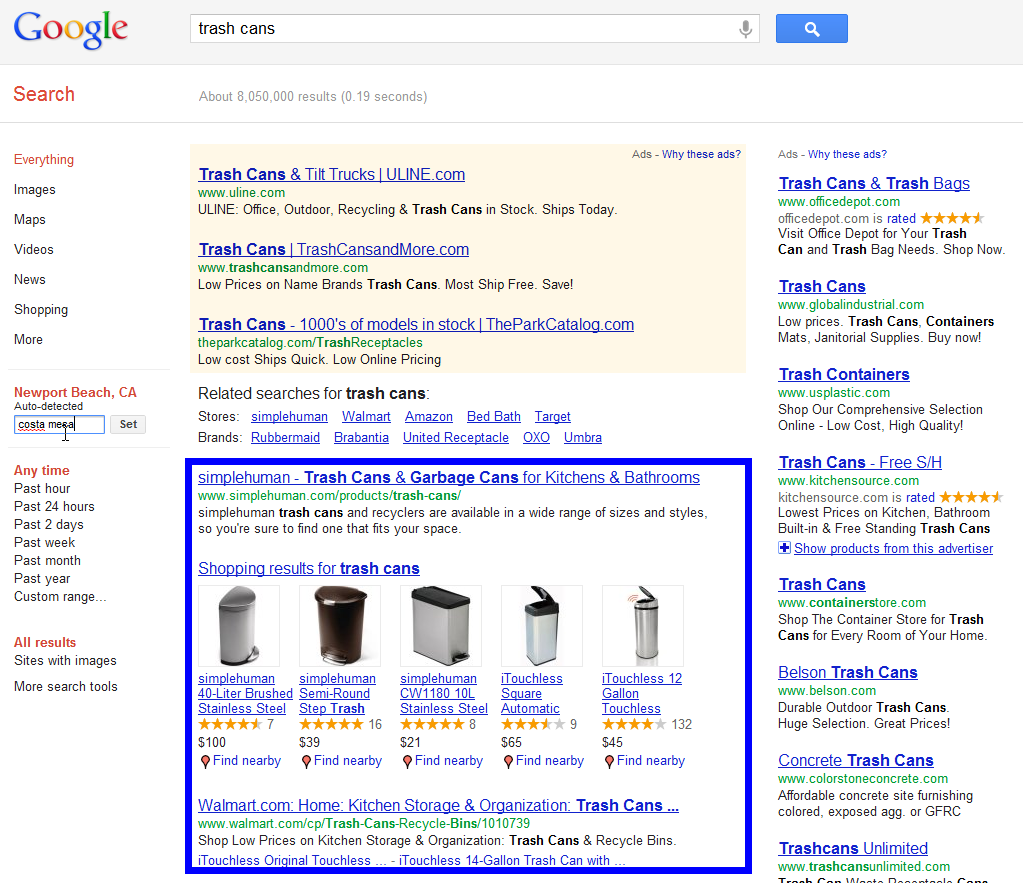
Another issue is that ads on Google’s own search results pages push the “content” — the unpaid editorial listings — down toward the bottom of the page. For example, here’s exactly what’s visible on my MacBook Pro’s 1680×1050 screen:

(Side note, that yellow color around the ads in the screenshot? It’s much darker in the screenshot than what I see with my eyes. In reality, the color is so washed-out that it might as well be invisible. That’s something some have felt has been deliberately engineered by Google to make ads less noticeable as ads).

The blue box surrounds the content, the search listings that lead you to actual merchants selling trash cans, in this example. Some may argue that the Google shopping results box is further pushing down the “real content” of listings that lead out of Google. But the shopping results themselves do lead you to external merchants, so I consider them to be content.

The example above is pretty extreme, showing the maximum of three ads that Google will ever show above its search results (with a key exception, below). Even then, there’s content visible, with it making up around half the page or more, if you include the Related Searches area as content.

My laptop’s screen resolution is pretty high, of course. Others would see less (Google’s Browser Size tool doesn’t work to measure its own search results pages). But you can expect Google will take “do as I say, not as I do” criticism on this issue.

Indeed, I shared this story initially with the main details, then started working on this section. After that was done, I could see this type of criticism already happening, both in the comments or over on my Google+ post and Facebook post about the change.

Here’s a screenshot that Daniel Weadley shared in my Google+ post about what he sees on his netbook:

In this example, Google’s doing a rare display of four ads. That’s because it’s showing the maximum of three regular ads it will show with a special Comparison Ads unit on top of those. And that will just add fuel to criticisms that if Google is taking aim at pages top-heavy with ads, it might need to also look closer to home.

NOTE: About three hours after I wrote this, Google clearly saw the criticisms about ads on its own search results pages and sent this statement:

This is a site-based algorithm that looks at all the pages across an entire site in aggregate. Although it’s possible to find a few searches on Google that trigger many ads, it’s vastly more common to have no ads or few ads on a page.

Again, this algorithm change is designed to demote sites that make it difficult for a user to get to the content and offer a bad user experience.

Having an ad above-the-fold doesn’t imply that you’re affected by this change. It’s that excessive behavior that we’re working to avoid for our users.

Algorithms? Signals?

Does all this talk about ranking signals and algorithms have you confused? Our video below explains briefly how a search engine’s algorithm works to rank web pages:

Also see our Periodic Table Of SEO Ranking Factors, which explains some of the other ranking signals that Google uses in its algorithm:

Name The Update & More Info

Today’s change is a new, significant ranking factor for our table, one we’ll add in a future update, probably as Va, for “Violation, Ad-Heavy site.”

Often when Google rolls out new algorithms, it gives them names. Last year’s Panda Update was a classic example of this. But Google’s not given one to this update (I did ask). It’s just being called the “page layout algorithm.”

Boring. Unhelpful for easy reference. If you’d like to brainstorm a name, visit our posts on Google+ and on Facebook, where we’re asking for ideas.

Now for the self-interested closing. You can bet this will be a big topic of discussion at our upcoming SMX West search marketing conference at the end of next month, especially on the Ask The Search Engines panel. So check out our full agenda and consider attending.

Postscript: Some have been asking in the comments about how Google knows what an ad is. I asked, and here’s what Google said:

We have a variety of signals that algorithmically determine what type of ad or content appears above the fold, but no further details to share. It is completely algorithmic in its detection–we don’t use any sort of hard-coded list of ad providers.

Thursday, January 5, 2012

30 New Changes in Google's Search Results and Algorithm

Here’s the list for December, 2011:

  • Image Search landing page quality signals. [launch codename “simple”] This is an improvement that analyzes various landing page signals for Image Search. We want to make sure that not only are we showing you the most relevant images, but we are also linking to the highest quality source pages.
  • More relevant sitelinks. [launch codename “concepts”, project codename “Megasitelinks”] We improved our algorithm for picking sitelinks. The result is more relevant sitelinks; for example, we may show sitelinks specific to your metropolitan region, which you can control with your location setting.
  • Soft 404 Detection. Web servers generally return the 404 status code when someone requests a page that doesn’t exist. However, some sites are configured to return other status codes, even though the page content might explain that the page was not found. We call these soft 404s (or “crypto” 404s) and they can be problematic for search engines because we aren’t sure if we should ignore the pages. This change is an improvement to how we detect soft 404s, especially in Russian, German and Spanish. For all you webmasters out there, the best practice is still to always use the correct response code.
  • More accurate country-restricted searches. [launch codename “greencr”] On domains other than .com, users have the option to see only results from their particular country. This is a new algorithm that uses several signals to better determine where web documents are from, improving the accuracy of this feature.
  • More rich snippets. We improved our process for detecting sites that qualify for shopping, recipe and review rich snippets. As a result, you should start seeing more sites with rich snippets in search results.
  • Better infrastructure for autocomplete. This is an infrastructure change to improve how our autocomplete algorithm handles spelling corrections for query prefixes (the beginning part of a search).
  • Better spam detection in Image Search. [launch codename “leaf”] This change improves our spam detection in Image Search by extending algorithms we already use for our main search results.
  • Google Instant enhancements for Japanese. For languages that use non-Latin characters, many users use a special IME (Input Method Editor) to enter queries. This change works with browsers that are IME-aware to better handle Japanese queries in Google Instant.
  • More accurate byline dates. [launch codename “foby”] We made a few improvements to how we determine what date to associate with a document. As a result, you’ll see more accurate dates annotating search results.
  • Live results for NFL and college football. [project codename “Live Results”] We’ve added new live results for NFL.com and ESPN’s NCAA Football results. These results now provide the latest scores, schedules and standings for your favorite football teams.
  • Improved dataset for related queries. We are now using an improved dataset on term relationships to find related queries. We sometimes include results for queries that are related to your original search, and this improvement leads to results from more relevant related queries.
  • Related query improvements. [launch codename “lyndsy”] Sometimes we fetch results for queries that are related to the original query but have fewer words. We made several changes to our algorithms to make them more conservative and less likely to introduce results without query words.
  • Better lyrics results. [launch codename “baschi”, project codename “Contra”] This change improves our result quality for lyrics searches.
  • Tweak to +1 button on results page. As part of our continued effort to deliver a beautifully simple user experience across Google products, we’ve made a subtle tweak to how the +1 button appears on the results page. Now the +1 button will only appear when you hover over a result or when the result has already been +1’d.
  • Better spell correction in Vietnamese. [project codename “Pho Viet”] We launched a new Vietnamese spelling model. This will help give more accurate spelling predictions for Vietnamese queries.
  • Upcoming events at venues. We've improved the recently released places panel for event venues. For major venues, we now show up to three upcoming events on the right of the page. Try it for [staples center los angeles] or [paradise rock club boston].
  • Improvements to image size signal. [launch codename “matter”] This is an improvement to how we use the size of images as a ranking signal in Image Search. With this change, you’ll tend to see images with larger full-size versions.
  • Improved Hebrew synonyms. [launch codename “SweatNovember”, project codename “Synonyms”] This update refines how we handle Hebrew synonyms across multiple languages. Context matters a lot for translation, so this change prevents us from using translated synonyms that are not actually relevant to the query context.
  • Safer searching. [launch codename “Hoengg”, project codename "SafeSearch"] We updated our SafeSearch tool to provide better filtering for certain queries when strict SafeSearch is enabled.
  • Encrypted search available on new regional domains. Google now offers encrypted search by default on google.com for signed-in users, but it’s not the default on our other regional domains (eg: google.fr for France). Now users in the UK, Germany and France can opt in to encrypted search by navigating directly to an SSL version of Google Search on their respective regional domains: https://www.google.co.uk, https://www.google.de and https://www.google.fr.
  • Faster mobile browsing. [launch codename “old possum”, project codename “Skip Redirect”] Many websites redirect smartphone users to another page that is optimized for smartphone browsers. This change uses the final smartphone destination url in our mobile search results, so you can bypass all the redirects and load the target page faster.